


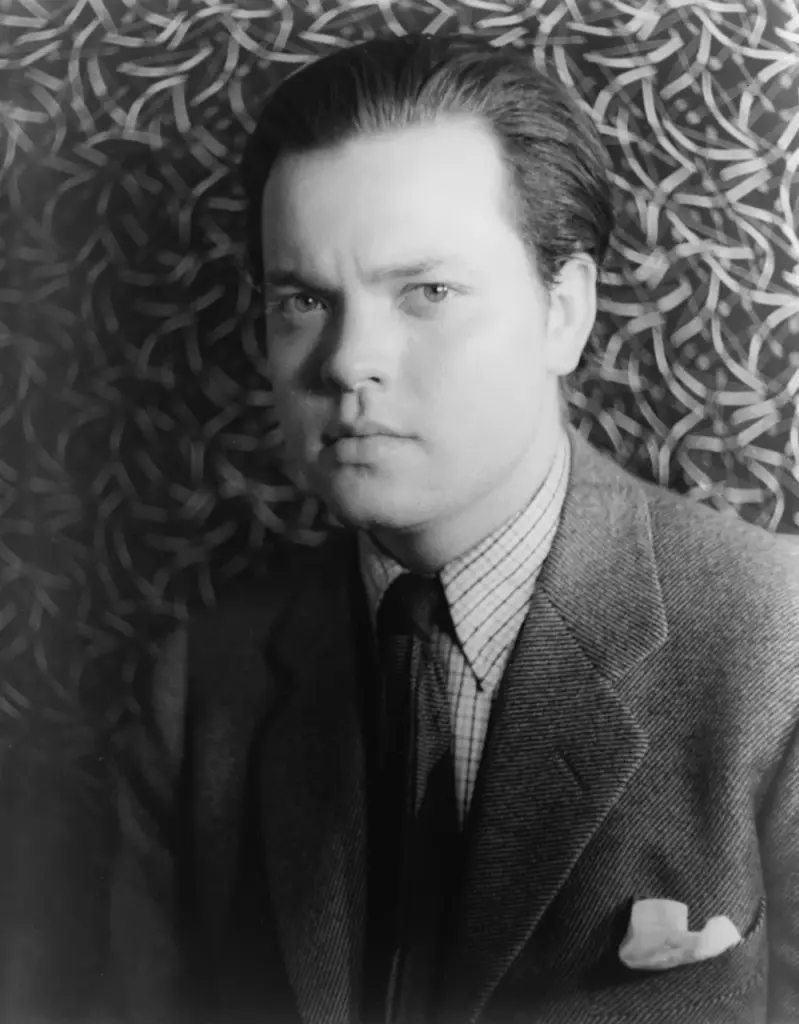
Orson Welles didn’t just “arrive” in Hollywood. He invaded it.
Most directors in the 1930s spent years working as apprentices, learning the “rules” of the studio system. Welles skipped the apprenticeship, ignored the rules, and at age 25, directed, produced, wrote, and starred in a film that most critics agree is the greatest ever made.
But when I look back at Welles’s career for Celebrimous, I don’t just see a prodigy. I see a warning. His story is the original battle between a singular artistic vision and the factory-like assembly line of the studio system.
To understand modern cinema—from the tracking shots of Scorsese to the non-linear editing of Christopher Nolan—you have to understand Orson Welles. He was the force of nature who taught the camera how to lie, and in doing so, found the truth.
From the Airwaves to the Screen: How Radio Shaped His Eye
Before he was a filmmaker, Welles was a voice. And if you listen closely to his early films, you can hear the radio DNA embedded in the celluloid.
By 1938, Welles was already a celebrity thanks to his work with the Mercury Theatre and his infamous War of the Worlds broadcast. We all know the story: he simulated a Martian invasion so realistically that he caused genuine panic across America.
But here is the detail most biographies miss: That broadcast wasn’t a prank; it was a masterclass in narrative manipulation. Welles learned that if you frame fiction as “news,” people will believe it. He took this lesson directly to Hollywood.
The Invention of “Overlapping Dialogue”
When I watch 1930s movies, the dialogue often feels stiff. Actor A speaks. Actor B waits. Actor A responds. It’s polite. It’s theatrical.
Welles hated that. In his radio work, he realized that in real life, people interrupt each other. They talk over one another. He brought this “overlapping dialogue” to Citizen Kane.
- The Technique: He would record audio tracks separately and mix them together, creating a “wall of sound.”
- The Result: It created a chaotic, urgent realism that cinema had never heard before. It’s a technique Robert Altman would later borrow, and one that makes Welles’s films feel shockingly modern in 2026.
Citizen Kane: Why is it Still the Best Film Ever Made?
It is easy to roll your eyes at Citizen Kane (1941) being at the top of every “Best of” list. Is it really that good? Or is it just a safe answer for critics?
As someone who dissects films for a living, let me tell you: It is the technical blueprint for everything you watch today.
RKO Pictures gave Welles the “Golden Ticket”—a contract that gave him total creative control and “final cut.” No first-time director had ever received this. Welles used that freedom to break every tool in the toolbox.
1. The “Deep Focus” Revolution
Most films in the 40s used “shallow focus”—the star was sharp, the background was blurry. This told the audience exactly where to look.
Welles and his cinematographer, Gregg Toland, perfected Deep Focus.
My Analysis: By using powerful arc lights and faster film stock, they kept the foreground, middle ground, and background in sharp focus simultaneously.
- Why it matters: It democratized the frame. As a viewer, you had to decide what was important. You could watch Kane in the background or the other characters in the foreground. It made the audience active participants rather than passive observers.
2. The Low-Angle Power Dynamic
Before Welles, cameras were usually placed at eye level (approx. 5 feet high). Welles cut holes in the studio floor to place the camera lower, shooting upwards at his characters.
The Psychology: This forced the audience to “look up” at Charles Foster Kane. It made him look like a titan, a giant, a tyrant. But importantly, because of the wide-angle lenses he used, it also distorted him slightly—hinting that his power was grotesque.
3. The “Ceiling” Innovation
This sounds trivial, but it changed set design forever. In the 1940s, movie sets didn’t have ceilings (because that’s where the lights went). Because Welles was shooting from the floor up, he needed ceilings. He had them built out of muslin cloth, hiding microphones above them. This added a claustrophobic, realistic weight to the rooms that other glossy studio films lacked.
The Tragedy of The Magnificent Ambersons: When the Studio Struck Back
If Citizen Kane is the triumph, The Magnificent Ambersons (1942) is the crime scene.
This is the part of the story that breaks every cinephile’s heart. While Kane was a critical success, it didn’t make a fortune. The studio system, threatened by Welles’s arrogance and lack of commercial conformity, began to turn on him.
Welles filmed Ambersons, a dark, melancholic story about the decline of a wealthy family (and the decline of old America in the face of industrialization). He considered it arguably better than Kane.
Then, the “Mutilation” happened: While Welles was in South America filming a documentary, RKO held a test screening. The audience didn’t like the depressing ending. Panicked, the studio took control.
- They cut 43 minutes of Welles’s footage.
- They burned the negatives to save storage space (yes, really).
- They hired a different director to shoot a “happy ending” that feels completely out of place.
When I watch the surviving cut today, it is a jarring experience. You are watching a masterpiece for 80 minutes, and then suddenly, you are watching a TV sitcom. It remains a cautionary tale for every modern director: If you don’t own the negative, you don’t own the film.
The Exile Years: Touch of Evil and the Long Shadow
Branded as “unemployable” and “erratic,” Welles spent decades wandering Europe, cobbling together funding from varied sources, acting in other people’s movies just to pay for his own film stock.
Yet, even in exile, he couldn’t stop innovating.
In 1958, he returned to Hollywood briefly to make Touch of Evil. The opening scene—a continuous, three-minute tracking shot following a car with a bomb in the trunk—is perhaps the most famous camera move in history.
What to watch for: Notice how the tension is built not by cutting, but by not cutting. We know the bomb is ticking. Every second the camera doesn’t cut, our anxiety spikes. This is pure “visual suspense,” a technique Spielberg would later master in Jaws.
Final Thoughts: The Price of Genius
Orson Welles died in 1985, leaving behind a trail of unfinished projects and legends.
In 2026, as we drown in algorithm-generated content and safe, franchise sequels, Welles feels more relevant than ever. He represents the “dangerous” artist. He reminds us that cinema is not just about pointing a camera at actors; it’s about using light, sound, and time to manipulate the human heart.
He was the “Ultimate Auteur.” He arrived as a conqueror, was exiled as a failure, and died as a legend. And if you ask me, he wouldn’t have wanted it any other way