


Before Hollywood invented the psychological thriller, and long before Tim Burton or David Lynch built careers on the surreal, there was a revolutionary art movement born from the ashes of a broken nation.
In the 1920s, Weimar Germany was reeling from the trauma of World War I. The economy was destroyed, the national psyche was fractured, and the people were disillusioned. From this despair, a cinematic movement emerged that rejected reality entirely.
This was German Expressionism.
It was a cinema of nightmares, populated by sleepwalkers, vampires, and tyrants. Its creators used distorted sets, painted shadows, and jarring camera angles not to document reality, but to project the inner, psychological turmoil of their characters onto the screen.
When I analyze film history for Celebrimous, I often say that all roads lead back here. This movement was short-lived, but its DNA was transported to Hollywood, where it became the skeleton key for every horror movie, noir, and sci-fi epic you love today.
A “Mindscape” of Twisted Reality
The core philosophy of German Expressionism is simple: Subjectivity over Objectivity.
In a standard Hollywood film of the 1930s, if a character was sad, they might cry. In a German Expressionist film, if a character was sad, the walls might tilt, the shadows might lengthen, and the world itself would warp to match their mood. The film is a “mindscape.”
The Distorted Set: The Cabinet of Dr. Caligari (1920)
If you only watch one film from this era, make it The Cabinet of Dr. Caligari. It is the purest example of the style.
My Analysis: When you watch this film, notice that the sets are not “built” in a traditional sense. They are painted canvases. The windows are jagged, non-Euclidean shapes. The streets zigzag in impossible directions.
- Why this matters: The director, Robert Wiene, didn’t want you to feel like you were in a German town. He wanted you to feel like you were inside the mind of an insane person. The distortion is the narrative. This technique of “externalizing the internal” is something modern directors like Ari Aster (Midsommar) still use today.
The Lighting of Fear: Chiaroscuro
You will see the term “Chiaroscuro” thrown around in film textbooks, but what does it actually mean for the viewer? It refers to high-contrast lighting—extreme brights and extreme darks, with very little “gray” in between.
In Expressionism, directors would often paint shadows directly onto the set floors and walls.
- The Technique: By painting the shadow, they ensured it wouldn’t move or fade. It was a permanent scar on the world.
- The Meaning: This wasn’t just aesthetic. It symbolized moral ambiguity. Characters were literally stepping out of the light (good) and into the blackness (evil).
The Great Exodus: How Hitler Shaped Hollywood
The death of German Expressionism in Germany was sudden and violent. As the Nazi party rose to power in the 1930s, they labeled this dark, avant-garde art as “degenerate.”
This led to one of the most significant mass migrations in art history. Germany’s greatest filmmakers—many of them Jewish—fled for their lives. They boarded ships bound for Los Angeles. Who came to Hollywood?
- Fritz Lang (Director of Metropolis)
- Billy Wilder (Future director of Double Indemnity)
- Robert Siodmak (Future Noir master)
- Karl Freund (Cinematographer of Dracula)
They arrived in sunny California with no money, but they brought something more valuable: their visual language. They couldn’t make abstract art films in Hollywood (the studios wouldn’t pay for it), so they applied their dark, cynical style to American genres.
The Birth of Film Noir: Expressionism with a Gun
This is the “Helpful Content” connection that connects the dots for students of film. Film Noir = German Visuals + American Crime Stories.
When these émigré directors were handed scripts about American detectives and femmes fatales, they filmed them the only way they knew how: like nightmares.
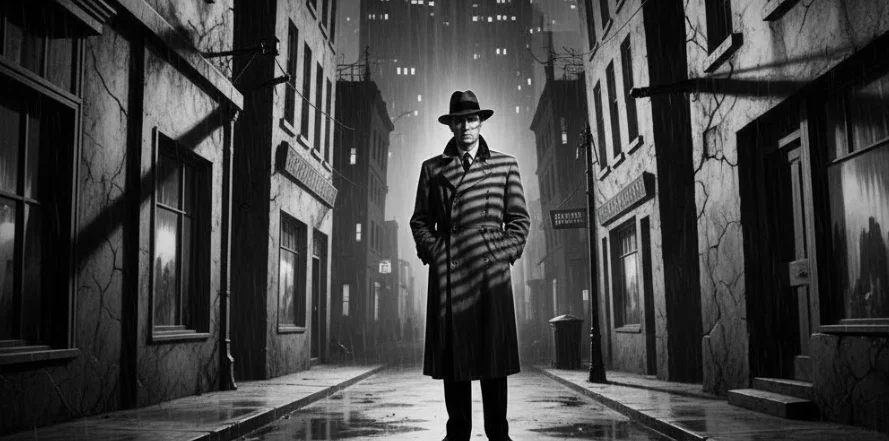
- The Venetian Blind Effect: In German films, shadows were painted bars. In Hollywood, directors used Venetian blinds to cast “prison bar” shadows across a detective’s face. It symbolized entrapment.
- The Rain-Slicked Streets: Just as Caligari used painted streets to show danger, Noir directors used wet pavement at night to reflect neon lights, creating a disorienting, mirror-like world where nothing is what it seems.
- The Dutch Angle: This is the technique of tilting the camera so the horizon line is not level. It creates instant unease. Hitchcock (who worked in Berlin in the 20s) used this masterfully, but it was invented by the Expressionists to show a “world out of balance.”
The Blueprint for Horror and Sci-Fi
The influence didn’t stop at crime. The visual vocabulary of our biggest blockbusters was written in 1920s Berlin.
Metropolis (1927) and Sci-Fi
Fritz Lang’s Metropolis is the grandfather of all sci-fi cinema.
The Connection:
- The Vertical City: Lang designed a city where the rich live in high towers and the workers slave in the underground. This vertical class divide is the direct inspiration for Coruscant in Star Wars and the Los Angeles of Blade Runner.
- The Robot: The “Maschinenmensch” (Machine-Man) in Metropolis is the visual predecessor to C-3PO.
Nosferatu (1922) and Horror
F.W. Murnau’s Nosferatu stole the plot of Dracula (and got sued for it), but it invented the cinematic vampire. Unlike the suave, caped vampires of later years, Count Orlok was a rat-like creature of pestilence. He brought plague, not seduction.
- The Shadow Scene: The famous shot of Orlok’s shadow creeping up the stairs—long fingers extended—proved that what you don’t see is scarier than what you do. This technique of “shadow horror” is still the standard for building tension in 2026.
The Enduring Legacy: From Burton to The Batman
Why does this matter today? Because the Expressionist aesthetic never died. It just evolved.
- Tim Burton: Watch Batman Returns or Edward Scissorhands. The pale faces, the black leather, the twisted gothic architecture—this is pure Caligari. Burton is arguably the most successful Neo-Expressionist in history.
- Matt Reeves‘ The Batman: The 2022 film is drenched in rain, shadow, and moral decay. It uses high-contrast red and black lighting that would make Fritz Lang proud.
Final Verdict: German Expressionism taught us that cinema could do more than record reality—it could distort it. It showed us that the most terrifying place isn’t a haunted house or a dark alley; it is the human mind. And every time a modern director tilts the camera or casts a long shadow to make you feel uneasy, they are tipping their hat to the masters of Weimar.